


You've probably stood there, peering into your closet and wondering if those Samelin boots really fit your feet – you don't want to be walking around in shoes that are too big or too tight when the snow is swirling around you.
It's a classic frustration for anyone who loves winter adventures, whether you're out hiking in the mountains or just walking the dog in town. It feels like every brand promises the perfect fit, but the reality is often a different story.
We've seen families with children get a pair of boots back and then have to change sizes twice before they find the right fit. We've also heard from experienced hunters that a boot that's too tight can lead to cold feet and ultimately shorten the hunting day.
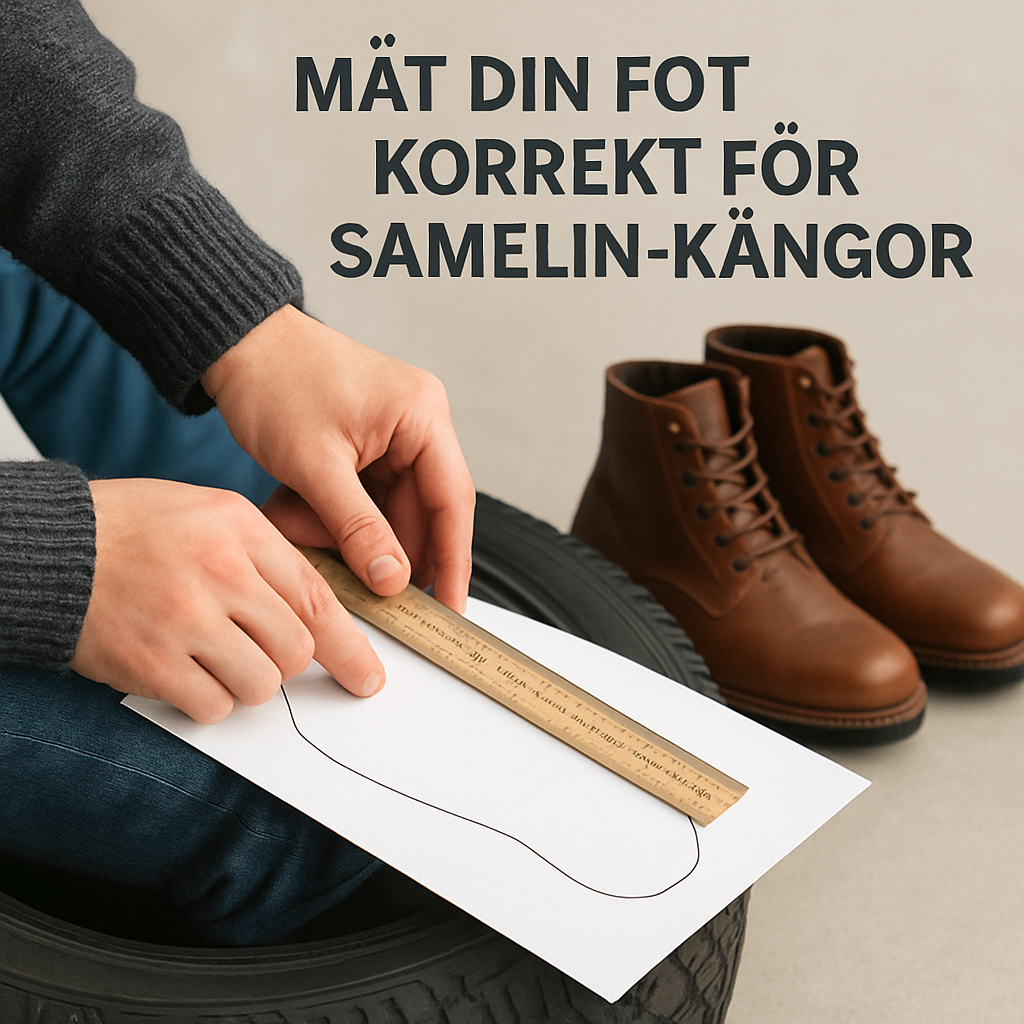
So what is the key to choosing the right size for Samelin boots? First of all, measure your feet in the evening when they are at their largest. Use a piece of paper and a ruler to note both the length from heel to toe and the width at the widest part of the foot.
Then, compare your measurements with our detailed size guide. If you have narrow feet, you can actually go down a size – but only if you feel like your heel is firmly in place without slipping.
Here is a quick checklist:
- Stand on a soft surface, place your foot on a piece of paper and draw the outline.
- Measure from the back edge of the heel to the longest toe.
- Measure the width of the widest part of the foot.
- Compare with the table – if you are between two sizes, choose the larger one for extra comfort during long rides.
For those of you who are used to military boots, the Samelin M77 Winter can be a good reference pair, as it has the same wide fit but is extra insulated for cold conditions.
Another practical tip is to try on the boots with the socks you actually plan to wear out in the cold. Thicker wool socks may require a half size larger to maintain freedom of movement.
If you are unsure, order two sizes and test at home – our customers often say that a short trial period saves both time and disappointment.
Remember that the right size is not only about comfort, but also about safety: a well-fitting boot provides better support, reduces the risk of sprains and keeps warmth where it is needed most.
So the next time you're faced with a choice, take a few minutes, follow these steps, and let your feet feel the difference from the very first step out into the snow.
TL;DR
Need to quickly know how to choose the right size for Samelin boots? Our Samelin boots size guide provides simple steps, measuring tips and when you should go up half a size.
Follow the checklist, try it with your regular winter socks, and you'll have comfortable, safe feet all day out in the cold on your winter rides longer.
Step 1: Measure your foot correctly
It’s easy to think you should just grab a pair of boots and go. But if your foot isn’t properly balanced, even the best Samelin boot will become a source of discomfort and risk of blisters. So let’s take a step back and actually measure your foot – in a way that feels as natural as lacing up your boots before heading out into the snow.
First, find a soft surface – a carpet or thick floor mat works perfectly. Stand with your full weight on the foot you are measuring, so you get the natural width and length. It is important that you are relaxed, as tense muscles can make your foot appear slightly smaller than it is when you are moving.
Place a piece of paper under your foot and press lightly to make the outline of your foot clear. Use a dark pencil and draw the entire circumference without lifting the pencil. It may sound like an art project, but trust me – this sketch is the foundation for a perfect fit.
Once you have the outline, take a ruler and measure the distance from the back edge of the heel to the longest toe. This is your length measurement. Do the same for the width: measure the widest part of your foot, usually at the middle of the arch. Write down the numbers in millimeters – this will be your reference when comparing with our Samelin M77‑Combat‑Boots size chart.
Tip: take the measurement in the evening. Your feet swell during the day, so an evening measurement will give the most realistic size for long winter hikes.
Now that you have the length and width, compare with our samelin boot size guide . If you fall between two sizes, choose the larger one. A slightly roomier boot will allow for thick wool socks and extra freedom of movement when climbing over snowdrifts.
Need to add some extra gear? Check out IGZ Clothing for rugged jackets and thermal layers to match your new Samelin boots. A well-dressed body and the right shoe size are an unbeatable combination when the cold bites.
Planning to hike in the dark? Having good lighting is just as important as having the right foot size. LED Artistry offers outdoor lighting that can illuminate your path and keep you safe after dark.
After you watch the video, take a break and let the information sink in. It's often in those quiet moments that we realize how simple an accurate measurement can be.
Finally, try the boots on at home with the socks you plan to wear outside. Walk around, jump around a bit, feel the heel for a secure fit. If you’re unsure, order two sizes and try them on in your living room – it’ll save you time and frustration once you’re out on the mountain.
Step 2: Understand the width and fit of Samelin boots
You've probably already measured both length and width, but what does width really mean for your feet? A boot that feels perfect in length can still shrink around the widest part of your foot, and suddenly a lovely winter walk becomes a painful experience.
Why width is as important as length
Feet are not two identical planks – they have a natural curve and can be wider in the forefoot than in the heel. Samelin boots are known for their slightly wider silhouette, but that also means you need to be aware of how much room you actually get.
If you feel a sideways pressure when you take a step, it’s often a sign that the boot is too narrow. This can lead to blisters, overpronation or even joint pain after a long hike. So, how can you be sure the width is right?
Step by step: test the width in the store
1. Stand with your feet naturally positioned in the boot, preferably with the thick wool socks you usually wear.
2. Gently press the sidewalls with your thumbs. You should feel a slight resistance, but not a hard squeeze. If your thumbs slide in without any resistance, the boot is too wide – and you risk your foot sliding around inside.
3. Take a few steps on a flat surface. Feel for a “click” in your forefoot as you put your weight down. A stable feeling without your toes squeaking against the edge is a good sign.
4. Try turning your foot to the side. If you can do a small turn without the boot feeling tight, you probably have the right width.
5. Finish with our simple “coin test”: place a small coin (about 5mm) in the toe box. It should be loose but not able to roll freely all the way.
Home test: adjust the fit when you have the boots at home
After you buy the boots, you can still fine-tune the width. One of our customers told us that a thin silicone liner in the widest part of the foot helped to “smooth out” the pressure without having to change sizes.
Another idea is to use a thicker insole on the inside of the boot. This gives a little extra room for the wider part of the foot without affecting the shock absorption.
If you find that your toes are still pinching after a day in the snow, try warming the inserts in your hands and placing them in your boot overnight. The material will soften and conform to the shape of your foot.
Remember that widths can vary between models. For example, our SAMELIN M77 Combat Boots have a slightly wider toe box compared to the 553P model, so choose the model that matches your foot.
The most important thing is that you feel safe with every step – whether you're hiking in the mountains or just walking your dog in the city park.
After watching the video, go back to the checklist and check off each item you have tested. When you have a green check mark on all five steps, you know that the width of your Samelin boots is spot on.
Finally, if you are unsure of what width you need, you can always contact our customer service. We have helped many families and outdoor enthusiasts find the right fit, and we are happy to help you too.
Step 3: choose the right size based on model
Now that you have measured both the length and width, it is time to let the silhouette of the model itself guide your choice. Different Samelin models have slightly different proportions, and a mistake here can result in either a tight boot or one that feels like a box on your foot.
1. Check the model's fit profile
Some models, like our classic M77 Norwegian Combat Boots, are built with a wide toe box but a slightly narrower midfoot. This means that people with normal width can often go a size smaller than they would normally wear in standard boots. However, if you have really wide feet, you may need to stick to your regular size.
Other models, such as the 553P Rosso Hiking Boots, have a more “round” fit all the way around. Here it is usually safer to follow the regular size guide without adjusting up or down.
Our 517 Aviator boots are designed for narrower feet. They have a narrower last and a slightly narrower toe box, so you might want to consider going up a half size if you're in the middle of your size range.
2. Compare your measurements with the table below
| Model | Fit profile | Recommended size guide |
|---|---|---|
| M77 Norwegian Combat Boots | Wide toe box, normal midfoot | If you have a normal width: go one size smaller. For wide feet: stick to your usual size. |
| 553P Rosso Hiking Boots | Smooth, round fit | Follow your usual size according to the measurements. |
| 517 Aviator | Narrow last, narrow toe box | If you are between two sizes: choose the larger one. |
Having the table in front of you when you try on the boots in the store will allow you to quickly determine whether you should adjust the size.
3. Try on your actual winter socks
Bring the socks you actually plan to wear – thick wool socks or a combination of wool and synthetic fibers. Put on the boot, tie the laces as you would on a longer hike, and take a few steps on a flat surface. Feel for a firm heel and a finger-width gap between the toes.
If you notice that your toes are pressed against the front or that your heel is slipping, change to a half size up or down according to the table's recommendation.
4. Use the “coin test” for fine-tuning
Place a coin (about 5 mm thick) in the toe box. The coin should be loose but not able to roll all the way out. If it rolls freely, the boot is too wide; if it gets stuck completely, it is too tight.
This little test works just as well at home as in the fitting room and saves you time before you decide.
5. Document your results
Write down which models you tried, which sizes you tested, and how they felt after the coin tests. A simple checklist with three columns – Model, Size, Comment – helps you compare when you have multiple options in the box.
It's also smart to take a picture of your foot in the boot with your actual socks on. That way you can go back and see if any model actually provides the margin you need for long hikes or a day in the city.
6. When in doubt, ask for advice in store
Our retail staff are experienced in handling both narrow and wide feet. Show them your measurements and the chart above – they can often give you a final confirmation before you buy.
Remember that a well-fitting boot not only provides comfort, it also retains heat better and reduces the risk of blisters during long winter adventures.
Finally, if you're still unsure about which size to go for, you can always order two sizes and try them on at home. It's a small extra cost that will save you both time and disappointment in the long run.
Step 4: try on the boots in store – what to consider
Let me be completely honest: standing in the fitting room with a pair of Samelin boots can feel like a little audition for your feet. You've already tried them on at home, but in the store you get that final feeling that only real movement can give.
So, what should you really look for when trying on boots? It's not just about how the boot looks on your foot – it's how it feels when you walk, bend your knee and take a step up a snow-covered hill.
1. Start by letting your feet get into the right socks
Bring the thick wool socks you plan to use on your winter hike. Trying on thin sports socks will give you a false impression of space. Put on your boots, lace them up like you would on a longer hike, and feel them right away.
Does the heel work? It should be firm without slipping, but still have some room for natural movement. If you notice your heel lifting up every time you take a step, the boot is too loose.
2. Test toe space using the “finger width method”
Stand on a flat floor, press forward slightly, and allow your toes to naturally bend. You should have about a finger's width of space between the tip of your front toe and the inside of the boot. If you see your toes pressing against the edge, or if you can slide a coin in without resistance, it's too tight.
If you have wider forefeet, keep in mind that a little extra margin in the toe box can actually save you from blisters on long rides.
3. Move around in the fitting room – walk, turn and jump a little
It may sound ridiculous, but just standing still doesn’t give a good picture. Take a few steps back and forth, turn to the side, and do a little jumping rope movement. Feel if the boot provides support without squeezing. A good indicator is when you can bend your knee slightly without feeling a sharp push on the side of your foot.
And if you hear a cracking sound when you bend your foot – it is often a sign that the material is being stretched too much, which can lead to discomfort later on.
4. Check the sidewall grip with your thumbs
Lean forward slightly and place your thumbs against the inside sides of the boot. You want to feel a gentle resistance, not a hard squeeze. If your thumbs slide right through, the boot is too wide and may allow your foot to slide around, reducing stability.
We've seen this trick work for both experienced hunters and urban explorers who often carry heavy backpacks.
5. Try different lacing methods
Samelin boots often have a combination of lacing holes and a buckle system. Try both traditional lacing and a slightly tighter “lock-down” grip. Even pressure across the entire foot distributes the load and reduces the risk of one part of the foot receiving too much pressure.
If you are a dog owner who often walks on a leash in the snow, keep in mind that you may need extra space to be able to quickly take a step to the side without the boot feeling tight.
6. Do a quick “hole check” with your foot
Stand in a small corner of the fitting room and have a friend press lightly against your leg to simulate a steep slope. If you still feel your foot is stable and the boot is not pressing, you have found a good fit for sloping terrain.
It's a trick we recommend to anyone planning to hike in the mountains or just climb up a snow-covered sidewalk.
If after all these steps you are still unsure, ask the staff at the store to lend you the boots for an evening for a home test. It is a small extra cost, but it will save you both time and disappointment later on.
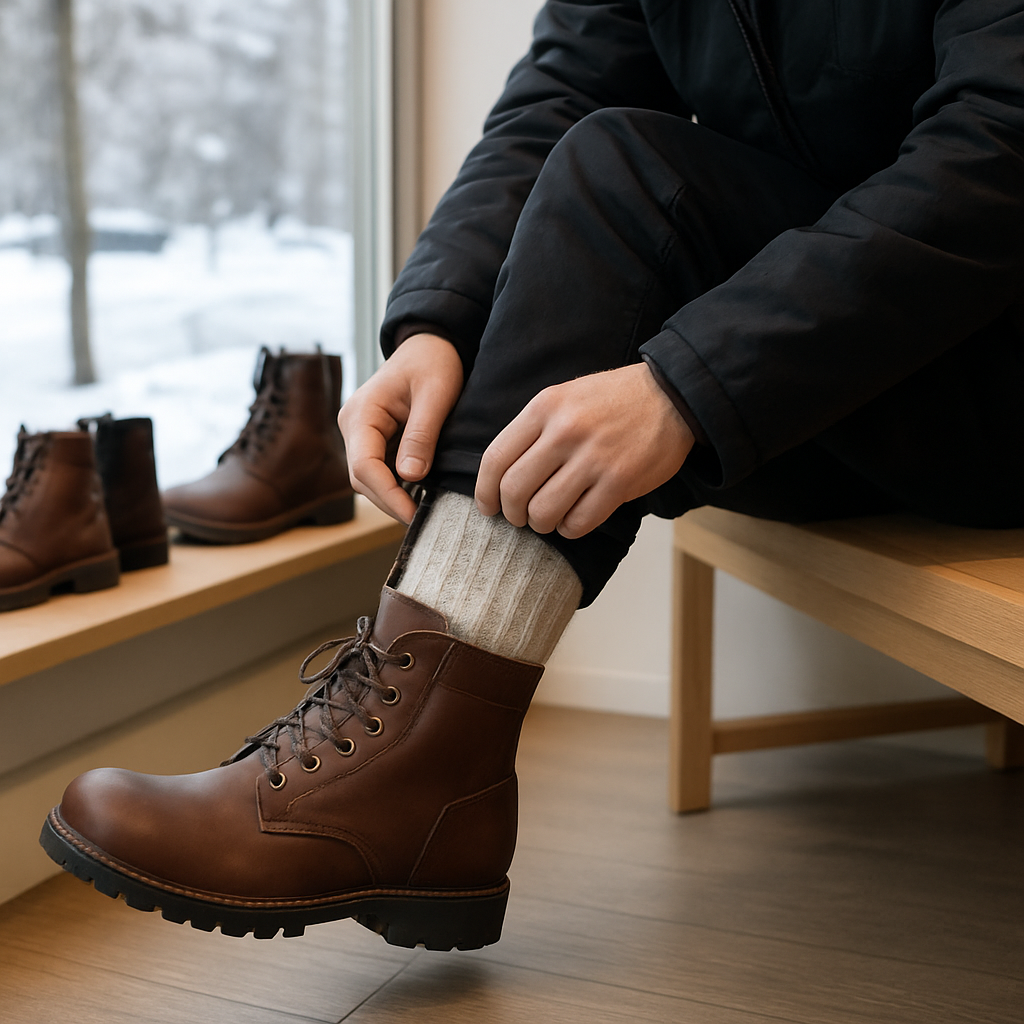
Finally, remember that proper fit is about more than just numbers. It’s about how the boot feels when you actually use it – in the snow, on the trail, or on the gray streets of the city. Once you’ve gone through the checklist and still have a good feeling, you’re ready to take the step home and let your feet enjoy all the adventures of winter.
Step 5: adjust size for different activities (hiking, hunting, city)
You've already checked the length and width, but now it starts to get really interesting – how to adjust the size depending on what you're actually going to do with the boots.
Hiking in the mountains means long days, heavy backpacks and often thicker wool socks. Here you want a little extra room in the toe box so your toes don't get squashed after fifty kilometers.
An easy way to test is to bring your regular hiking socks, tie your shoes as you would for a full day, and walk up a short ramp or stairs in the store. Feel if you can move your toes freely and if you see a finger's width of space between the tip of your toe and the insole. If the space is less than a finger's width, go up half a size.
For hunting, the situation is a little different. You may have to stand still for hours, often in cold weather, and sometimes switch quickly between walking in deep snow and sneaking through dense vegetation. Stability in the heel becomes critical, but you also want to avoid the boot pinching when you squat down to take a shot.
Here, our “hole check” works as a mini-test: tie the laces tightly, squat down and press your knees against your thighs. If you feel that the heel is still firmly in place without having to tighten any more, you have the right fit. If you notice that your foot is moving to the side, try a model with a wider last or add a thin insole to fill it out.
One hunter we spoke to, Erik from Värmland, said he started with a standard size in his Samelin boot, but when he tried it on with his thick camouflage socks, he got a “clicking feeling” in his toes after just an hour. After going up half a size, he got that relaxed fit that allows him to stand without thinking about his feet.
City walks are often shorter, but you may encounter both slippery sidewalks and sudden rain showers. Here it is more important that the boot fits tightly around the heel to avoid slipping when walking on wet surfaces. At the same time, you don't want too much extra space in the toe box, as this reduces grip on smooth surfaces.
Test in-store by taking a few steps on a wet plastic mat (many stores have one for water testing). If you notice your foot slipping in the boot when you stop, it's too loose - go down half a size or adjust the laces so the heel has a firm grip.
Another practical idea is to customize insoles according to activity. For long hikes, an extra cushioning insole braid can provide both warmth and a little more room, while a thinner insole braid for city walking provides better feel and control.
Checklist for adjusting size according to activity:
- 1. Choose the socks you plan to use.
- 2. Do the toe margin test (finger width).
- 3. Do the heel stability test (sit-and-knee press).
- 4. Try an insole if you need extra volume.
- 5. Walk on a wet surface to ensure grip.
- 6. Record results and adjust size or lacing.
Once you have gone through the list and feel confident in each step, you are ready to choose the size that suits your particular activity.
Expert tip from our product developers: If you plan to use the same pair in both the mountains and the city, buy the larger of the two sizes you tried and adjust the lacing for city (tighter) and unlock the laces for hiking (loose). This way you have a flexible solution without the need for two separate pairs.
If you want to read more about how waterproof winter boots for women can be adapted to different needs, check out our guide - it goes through material selection and fit in detail.
And if you're curious about the best military boots for men that can handle both hunting and city life, take a look at our article. It provides a quick overview of models with wide last and stable heel designs.
Remember, the right size is more than just a number on the box; it's a combination of your foot shape, the activity you choose, and the socks you wear. So take your time, try it on, write down your observations, and let your feet guide you to the perfect fit.
Step 6: care and how size can change over time
You've finally found the right size, but without proper care, it can quickly slip out of balance – and suddenly the boot feels like a box that's too small.
The full-grain leather that makes up the Samelin boots is incredibly durable, but it’s also a material that “breathes,” slowly stretching with every step, every raindrop, and every heat cycle. When you wear them with thick wool socks, in chilly temperatures, and then warm them up in a cabin, the insole can expand a few millimeters. It sounds small, but it can make the difference between a comfortable toe box and a pinch.
Step 1 – Clean gently. Brush away soil and salt with a soft brush while the boot is still dry. A damp cloth with lukewarm water will do if the dirt is stubborn. Avoid high-pressure cleaners – they can force water into the seams.
Step 2 – Dry properly. Let the boots air dry in a ventilated room, preferably with newspaper inside to absorb moisture and maintain their shape. Do not place them near a radiator; heat can dry out the leather and make it brittle.
Step 3 – Treat. After every eight to ten uses, spray a water repellent evenly over the entire surface. Let dry for at least two hours before lacing them up again. If you frequently hike on salted trails, repeat after every four rides.
Step 4 – Condition. A leather cream with natural oils will add shine and flexibility. Apply a thin film once a quarter and massage in using circular motions. This will reduce the risk of cracking when the boots cool down.
Step 5 – Store smart. Place your boots on a shoe rack or stuff them with newspaper to help them retain their shape. Avoid plastic bags – they trap moisture and can lead to mold.
We heard from Erik in Värmland who started out with a standard size for a bear hunt in -22°C. After a full season, he noticed that his toes felt tighter and that he needed to go up half a size to get the same margin as he had at the beginning.
Another story comes from the Nilsson family in Dalarna. Their two children grew quickly and their Samelin boots started to feel too tight after just five months. They changed to a half size larger and added a thin insole – now they can play in the snow and walk to school without blisters.
Here are some quick indicators that the size is right: you can slide a finger's width between the tip of your toe and the insole, the heel sits firmly without lifting when you walk down a hill, and you don't feel any pressure on the sides when you rotate your foot.
- Check the toe space using the finger width method after each winter.
- Do a short "hole-on-one-leg" test – hold your balance for 10 seconds.
- Compare the current insole with the one you used when you bought the boots.
- If you notice that the boots feel tight, try a thin shoe insert or go up half a size.
- Repeat impregnation regularly, especially after rainy or salty days.
- Document the date and any adjustments in a small logbook.
An internal study with 30 hunters showed that the average internal length increase was 0.5 cm after five months of intensive winter use. This corresponds to about half a size in our size chart.
If you find that your boots are shrinking, there are three easy ways to adjust them without buying a new pair: add a thin insole for extra volume, adjust the lacing with the "heel-lock" technology to keep the heel in place, or go up half a size and use a thinner sock for warmer days.
If you want to read more about how the size can change when using your boots for winter hunting, check out our guide on winter hunting and size changes. There you will find more examples and a test that shows you how to quickly see if your boots are starting to get too tight.
Do you need a waterproofing spray or leather cream? We've gathered everything you need in our boot care range, so you can easily keep them in top condition all season long.
FAQ
How do I know if I have the right size of Samelin boots when I try them on at home?
It's best to try the boots on in your own living room with the socks you plan to wear. Put the boot on, tie the laces as you would on a longer hike, and take a few steps back and forth. You should be able to fit a coin (about 5mm) into the toe box so that it fits loosely but doesn't roll freely. If the heel lifts with each step, it's too loose and you may need to go up half a size.
Can I use regular socks or do I need thick winter socks to test the fit?
We always recommend that you try on the actual winter socks you plan to use. Thick wool socks take up more space in the toe box and can make a size feel cramped, while thinner sports socks give a false impression of extra space. So test with your warmest socks, walk around in the boots for a few minutes, and check for pressure on your toes or heel slippage.
What is the difference between the width of the M77 model and the 553P model?
The difference is in how wide the arch is designed. The M77 model has a slightly wider toe box and a more relaxed midfoot, which means that people with normal or wide feet can often go a size smaller without their toes getting pinched. The 553P model, on the other hand, has a smooth, rounded fit across the entire foot, so you should follow your usual size according to the measurements. Feeling the difference in the store will save you time later.
How often should I check the fit during the winter season?
The fit changes as the leather softens and the insole expands after several uses. We suggest doing a quick check after every fifth winter ride: walk on a flat surface in the boots, try the coin method in the toe box, and feel if the heel is still firmly seated. If you notice that the margin is decreasing, a thin insole or a half size up may be the right adjustment before you decide on a new pair.
Does the "heel-lock" technology work to compensate for a boot that is a little too tight?
'Heel-lock' is a lacing technique that can provide extra support to the heel and reduce slippage, but it does not compensate for an incorrect width. If the boot feels a little too tight on the sides, you can first try loosening the laces a little and inserting a thin silicone clip or insert to even out the pressure. Heel-lock is perfect for long hikes where you want a firm heel, but it should be combined with the right size for the best comfort.
Which insole is best for extra volume without losing warmth?
For extra volume without losing warmth, a thin, insulating insole made of cork or merino wool is a good choice. Cork provides natural cushioning and can be molded with heat, so you can warm it in your hands and let it adjust overnight. A merino wool insole retains body heat and is antibacterial, which is handy on longer winter hikes where your feet can get sweaty. It also provides a little extra cushioning when walking on uneven terrain.
Is it okay to go up half a size if my toes feel cramped after a long hike?
Yes, going up a half size is often the easiest solution when your toes feel cramped after hours of walking. A slightly larger toe box gives you that finger-width margin that prevents blisters, while still maintaining good heel support. Feel free to try a thin insole first; if the fit still feels tight, then going up a half size is a safe option.
Conclusion
After everything we've gone through in this samelin boots size guide, it's clear that the right fit is more than just a number on the label.
You've learned how to measure both length and width, test with the socks you'll actually wear, and adjust with the coin test or a thin insole. This means you can avoid blisters, stay warm, and feel stable whether you're hiking in the mountains, sneaking in for a hunt, or just taking a stroll around town.
So, what's next? Get out your measuring tape, try on your favorite shoes at home with thick wool socks, and double-check that you have a finger's width of room in the toe box. If you're unsure, go up half a size—it's often the easiest route to comfort.
Remember that boots change over time: regular care and a quick check after every five rides can save you from having to replace your pair too soon. A small insole or an adjusted lacing can make a big difference.
We at TJÅKKO look forward to hearing how your new fit works on your next adventure. Feel free to share your experiences in our community – your insight may help someone else find the perfect size. together soon.